Practice Paper for SBI PO Prelims Exam 2015

Dear Readers,
                         We are providing Practice paper for SB PO Preliminary Exam 2015 which we hope will be helpful for the exam. Hope you all like the post!
CLICK HERE SBI PRELIMINARY EXAM 2015 7

CLICK HERE SBI PRELIMINARY EXAM 2015 6

CLICK HERE SBI PRELIMINARY EXAM 2015 5

CLICK HERE SBI PRELIMINARY EXAM 2015 4

CLICK HERE SBI PRELIMINARY EXAM 2015 3

CLICK HERE SBI PRELIMINARY EXAM 2015 2

CLICK HERE SBI PRELIMINARY EXAM 2015 1


Practice Paper for SBI PO Prelims Exam 2015

Dear Readers,
                         We are providing Practice paper for SB PO Preliminary Exam 2015 which we hope will be helpful for the exam. Hope you all like the post!
CLICK HERE SBI PRELIMINARY EXAM 2015 6

CLICK HERE SBI PRELIMINARY EXAM 2015 5

CLICK HERE SBI PRELIMINARY EXAM 2015 4

CLICK HERE SBI PRELIMINARY EXAM 2015 3

CLICK HERE SBI PRELIMINARY EXAM 2015 2

CLICK HERE SBI PRELIMINARY EXAM 2015 1


Practice Paper for SBI PO Prelims Exam 2015

Dear Readers,
                         We are providing Practice paper for SB PO Preliminary Exam 2015 which we hope will be helpful for the exam. Hope you all like the post!
CLICK HERE SBI PRELIMINARY EXAM 2015 5

CLICK HERE SBI PRELIMINARY EXAM 2015 4

CLICK HERE SBI PRELIMINARY EXAM 2015 3

CLICK HERE SBI PRELIMINARY EXAM 2015 2

CLICK HERE SBI PRELIMINARY EXAM 2015 1


Practice Paper for SBI PO Prelims Exam 2015

Dear Readers,
                         We are providing Practice paper for SB PO Preliminary Exam 2015 which we hope will be helpful for the exam. Hope you all like the post!

CLICK HERE SBI PRELIMINARY EXAM 2015 4

CLICK HERE SBI PRELIMINARY EXAM 2015 3

CLICK HERE SBI PRELIMINARY EXAM 2015 2

CLICK HERE SBI PRELIMINARY EXAM 2015 1


Practice Paper for SBI PO Prelims Exam 2015

Dear Reader,
                         We are providing Practice paper for SB PO Preliminary Exam 2015 which we hope will be helpful for the exam. Hope you all like the post!


CLICK HERE SBI PRELIMINARY EXAM 2015 3

CLICK HERE SBI PRELIMINARY EXAM 2015 2

CLICK HERE SBI PRELIMINARY EXAM 2015 1


Practices Paper SBI PO Prelims 2015

Dear Reader,
                      We are posting Practices paper SBI PO Prelims 2015. It will be help full SBI PO Preparation 2015. For Download click the following link.


Click Here for Practice paper
Click Here For Answer

You might also like


Practice Paper SBI Prelims Set -1


Practices paper SBI PO Prelims 2015

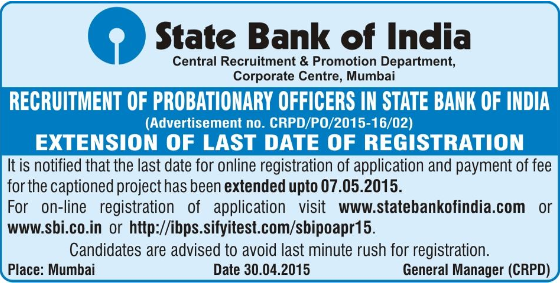
SBI PO Extend Last Date of Registration

Dear Reader,
                     Requirement  of  Probationary  Officers  in State Bank of India extend last date of  registration. Hurry up, Fill the form.

LAST DATE FOR APPLYING - 07-05-2015

Click Here to View More Details


Quiz On Data interpretation for SBI PO Mains 2015

Directions (Q. 1-5): Study the given bar graph and pie chart to answer the following questions.
The bar graph shows the production (in thousand tonnes) of Wheat, Rice and Maize in different states. 
Quiz On Data interpretation  for SBI PO Mains 2015

1. The productivity of which state is the maximum?
1) Bihar 
2) Haryana 
3) Punjab
4) UP 
5) MP

2. The production of which state is the maximum?
1) Bihar 
2) MP 
3) Haryana
4) UP 
5) Punjab

3. The production of Wheat in Punjab is what per cent more than the production of Maize in Odisha?
1) 350% 
2) 250% 
3) 300% 
4) 200% 
5) 400%

4. What is the ratio of the production of Rice in Bihar to the production of Wheat in Haryana?
1) 2 : 3 
2) 3 : 2 
3) 2 : 1 
4) 1 : 1 
5) 1 : 2

5. If MP exports 40% of Rice at the rate of `30 per kg and UP exports 30% of Rice at the rate of `32 per kg, then what is the ratio of the incomes from the exports?
1) 65 : 48 
2) 31 : 42 
3) 43 : 54 
4) 57 : 62 
5) 1 : 2

Directions (Q. 6-10): Study the bar chart carefully to answer the questions given below:
The number of factories of various industries in India and Pakistan
Quiz On Data interpretation  for SBI PO Mains 2015


6. If the ratio of production of Steel in India to that in Pakistan is 5 : 3 and the production of Steel in India is 1000 tonnes, what is the ratio of the productivity (production/no. of factories) of Steel in India to that of Pakistan?
1) 5 : 4 
2) 4 : 3 
3) 3 : 2 
4) 2 : 1 
5) 1 : 9

7. What is the difference between the total number of factories in India and that in Pakistan?
1) 250 
2) 150 
3) 50 
4) 5 
5) 100

8. The number of Cotton factories in Pakistan is what per cent of the total number of Cement factories in India?
1) 53.5% 
2) 59.9% 
3) 57.14% 
4) 50% 
5) 48.7%

9. If Pakistan and India export 40% and 30% respectively of their production of Fertilizer, then what is the difference between the amounts of Fertilizer they used for themselves? (The production of Pakistan is 50 tonnes per factory and that of India is 60 tonnes per factory)
1) 15 tonnes 
2) 0 tonne 
3) 35 tonnes
4) 32 tonnes 
5) 11 tonnes

10. If the production of Cement in India is 24500 tonnes and that in Pakistan is 14500 tonnes, then what is the difference between their productivity (production/ number of factories)?
1) 4.3 tonnes 
2) 6 tonnes 
3) 5.714 tonnes
4) 8.2 tonnes 
5) 7.9 tonnes

Answer:-

1. (2);Productivity = Total production/Area of agricultural land Productivity of Haryana
= (25+35+30)x1000/ [2x (8/100)] = 90000/16000
= 5.625 tonnes per sq km
  Productivity of Haryana is the maximum.

2. (5); Production of Punjab is maximum = 105000 tonnes

3. (3); Production of Wheat in Punjab = 40000 tonnes

4. (4); The ratio of production of Rice in Bihar  to the production of Wheat in Haryana 
= 25000 tonnes : 25000 tonnes = 1 : 1

5. (1); Income of MP from export of 40% of Rice at the rate of `30 per kg
= 32500 x (40/100)x 30  = `39 crore
Income of UP from export of 30% of Rice at the rate of `32 per kg
= 30000 x (30/100) x 32 = `28.8 crore
Reqd ratio = 39 : 28.8 = 390 : 288 = 65 : 48


6. (1); Production of Steel in India = 1000 tonnes
Productivity of Steel in India =  1000/ 8000 
= 1.25 tonnes per factory
Production of Steel in Pakistan = 1000 x (3/5) 
= 600 tonnes
Productivity of Steel in Pakistan = 600/600
= 1 tonnes per factory
Reqd ratio = 1.25 : 1 = 125 : 100 = 5 : 4

7. (5); Total factories in India = 300 + 500 + 500 + 700 + 800 = 2800
Total factories in Pakistan = 500 + 400 + 700 + 500 + 600 = 2700
  Reqd difference = 2800 – 2700 = 100

8. (3); Total number of Cotton factories in Pakistan = 400
Total number of Cement factories in India = 700
  Reqd % = (400/700) x 100 = 57.14% of the number of Cement factories in India.

9. (2); Production of fertilizer in Pakistan = 50 × 700 = 35000 tonnes
Export of Pakistan is 40% of its production. Then, the Fertilizer used by Pakistan itself
= 35000 (60/100) = 21000 tonnes.
Production of Fertilizer in India = 60 × 500 = 30000 tonnes 
India exports 30% of its production. So, Fertilizer used by India itself
= 30000 × (70/100)  = 21000 tonnes
  Reqd difference = 21000 – 21000 = 0 tonne

10. (2); Productivity of Cement = Production per factory
Productivity of Cement in India =  35 tonnes
Productivity of Cement in Pakistan 
= (14500/500) = 29 tonnes

  Reqd difference = 35 – 29 = 6 tonnes

You might also like.

Data Interpretation Quiz Set 1

Previous Year Paper For SBI PO 2105

Dear Reader, We are posting previous year paper. Which Will be helpful for SBI PO 2015 exam. Focus on below article.


1. What is Stale Cheque:  A cheque that’s date is past 3 months is considered stale and will often not be honored for cash or deposit at a bank.


2. Who is new Army Chief of India: Lt. Gen Dalbir Singh Suhag

3. What is Bancassurance: the selling of life assurance and other insurance products and services by banking institutions.

4. Cities where 10rs plastic notes will be introduced for field trial: Jaipur, Shimla, Bhubaneshwar, Mysore and Cochin.

5. Flying test bed aircraft developed by HAL and handed over to DRDO -  NABHRATHNA

6. Second Indian firm to be featured in Forbes Global 2000 list: SBI (State Bank of India)

7. Finance Ministry directed all PSBs to maintain what %of CASA: 40%

8. Author of Book: The Himalayan face off: Shishir Gupta

9. At which rate reserve bank give loans to commercial bank: Repo rate

10. Foreign currency exchanged rate is called: Forex rate or Foreign Exchange rate

11. Who won national women football championship: Manipur

12. APJ Abdul Kalam was awarded with Knighthood Award. Knighthood Award was given in which field: awarded on merit, for exceptional achievement or service.

13. International Women’s day is celebrated on: 8th March

14. RBI measure to liquidate the market: Repo rate

15. RUpay launched in India by which organization:: NPCI (National Payments Corporation of India)

16. Common Wealth Games 2014 will be held in: Glasgow, Scotland
Note:i. The 2018 Commonwealth Games  will be held in Gold Coast City, Queensland, Australia.

17. Cadbury's India new name: Mondelez India Foods Ltd

18. IIFA International Entertainer: John Travolta 

19.  KYC related to: Know Your Customer (a term used for customer identification).

20. Who is the chairman of TATA GROUP -  Cyrus Mistry

21. Full form of EFT: Electronic Fund Transfer

22.  Fastest mode of transaction: RTGS

23.  Alphanumeric code on cheque? Indian Financial System Code (IFSC) is an alphanumeric code is printed on cheque.
Note: MICR is a 9 digit code.

24.  Bank pays interest on savings account ? Daily Basis

25.  Function of banking ombudsman?

26.  Author who got Padmabhushan? Ruskin Bond

27.  World Snooker Women Champion: Steve Davis

Some Computer Questions:

1.    .xls, .doc. are : Extensions

2.    Server is used to share date with other computer due to: Network

3.    Word Processing software is used to output : Word Document

4.    Lifting software unethically - software piracy

5.    Computer which can be used by only one person: Personal Computer

6.    A computer which connects to other computer and sends information is? Remote Desktop

7.    How can u see the contents of a file? by clicking 

8.    Question regarding operating System?

9.    Computer basically performs on: binary numbers

10.  Which of the following is not a hard ware device:  icon


Some Marketing Questions:

1.    Goals in two fold marketing

2.    New policy in marketing?

3.    Marketing function?

4.    If a firm thinks 'its 5 times costlier to attract a new customer rather than maintaining the old one', then what should be inferred?

Note :- Focus On GK topic according these question.

previous year paper for sbi po 2105

SBI PO 2015 : Formal Letter Format

Dear Reader, We are posting Formal Letter Format and also presenting tips for witting a letter in exam. which will be help full for SBI PO Exam 2015.

The key to the success of the era of globalization is communication. And correspondence (letters) is perhaps the most important component of communication. Even in the age of modern technological innovations like e-mail, internet and long distance connectivity, letters still carry the maximum load of personal and business communication.
Whatever be the medium of carrying the message, the message has to be properly written to convey the required meaning and complete sense. One has liberty to write personal letters as one wants, but business or formal letters have to follow some norms in order to make appropriate impact.

What is the importance of letter writing ?
Letter writing is an important and effective tool. Letter writing helps you put something
concrete in hand on cumpuer that helps you iron out a position or reinforce something you may have talked about.

There are several types of letters – like application and appreciation, enquiries and requests, Complaint and Recommendation, Sales and Promotion, Welcome or Invitation letters. Mainly we have to study two types of letters. But we are talking about Formal Letter Format.

Formal Letters – They can be related to business, institution or educational purpose. The
format has to be followed while writing a formal letter.

Tips For write a letter:-

You must write good letters. And good letters come from careful writing as all literate people
reading your letter are surprisingly talented at quickly spotting errors or gaffes in the writing of other people. Here are some common tips –

  • Keep paragraphs short, preferably fewer than five lines. Vary the length of your sentences. 
  • And don’t be afraid to begin sentences with conjunctions (and, but, or). To emphasize a point, you can use a one – sentence paragraph.
  • Think twice before using any adjectives or adverbs. Impress people with your nouns and verbs, not with decorations.
  • Use a friendly, conversational tone. Also, keep it deferential.
  • Show confidence but not arrogance.
  • Avoid unclear phrases like “enclosed please find my resume for your perusal”. Be more creative than that.
  • Avoid vague statements. Give specific statements : people will find it both refreshing and easy to understand.

There are mainly five points that have to be taken care of while writing a letter. These are-
(a) Heading
(b) The Salutation or courteous greetings
(c) Subject
(d) The Body of the letter – communication or the message
(e) The Subscription – courteous leave taking, or conclusion
(f) The Signature Name of the writer

(a) HEADING
Heading of a letter basically consists of Two Parts :-
(i) address of the writer followed by
(ii) the date on which the letter was written by him.
Heading can be written on the Right or Left (keep on changing with time-presently we follow the
convention of writing heading in the left corner) corner of the first page of the letter.
Examples of a Heading are
63, Vinay Colony
Delhi-160032
June 12, 2010

(b) SALUTATION
The Salutation in the letter will depend upon the depth of relationship of the Writer with the person
to whom the letter is being written, thus it varies from letter to letter.
Salutation is written at the left hand of the page, at a lower level the Heading. The first and last
word of the salutation are always started in Capital Letters (of alphabet).
Examples of the salutation are:
Formal Letters
1. To officials/Principal/Headmaster/Teachers
Sir,
Madam,
2. To Businessmen:-
Dear Sir,
Dear Sirs,

(c) Subject: 
After the salutation comes the subject line where you have to mention the purpose of the letter in short. Make sure that the subject line is in upper-case characters and is aligned either to the left or to the center.

(d) BODY
The body itself is considered as the life of the letter and the style in which it is written will depend
upon the kind of letter one wishes to write. Like, the style of the letter to be written will be entirely
different from the style of the letter to be written to an official and so on. But few points that one
has to keep in mind irrespective of the style while writing the body of the letter are-
Divide the letter into various paragraphs to mark changes of subject-matter etc.
Use simple and direct language in short sentences. It will make the message clear and to the
point. ˆ Always try to be complete. For this, think out what you want to say before beginning to write a letter; and put down all the point in logical manner.

(e) SUBSCRIPTION
The subscription of the letter i.e. the end should be according to the sharing of the letter. A letter
must not end abruptly as this would look rude. So certain forms of polite leave taking are prescribed
that should be written after the last words of the letter on the left hand side corner of the lines after
the body. It should start with a capital letter and end with a comma. Some examples of the
subscription of the letter of various kinds are:-
1. To Principal/Headquarter/Teacher etc: Yours obediently
2. To Officials/Businessmen: Yours faithfully,
3. To Strangers : Yours truly
Note : Never use apostrophe (‘) with ‘yours’ in the subscription (your’s is incorrect).

(f) SIGNATURE  
The signature of the writer of the letter should be below the subscription. In a letter to the stranger,
the signature should be clearly written so that he could know whom to address in reply.

Formal Letter Format:- With Example
Write a leave letter to your Branch Manager. Hiba, Canara Bank, R. K. Puram Branch

New Delhi-22
6 November, 2008.
Branch Manager,
Canara Bank, R. K. Puram Branch
New Delhi-22.
Sir,
As my mother is admitted in a hospital at Agra for an operation, I have to be with her. Hence, it
would not be possible for me to attend office for two weeks. Kindly grant me special permission
to take 15 days leave.
Thank you,
Yours Truly,
Malv

sbi po 2015 : formal letter format

Editorial on A Savage New World of Terrorism

The Islamist terror network has grown into a hydra-headed phenomenon. This has consequences far beyond the current arc of terrorist violence, which for the moment is confined to the regions of Asia and North Africa. But countries like India are already feeling the heat. Hence, counterterrorism agencies should not be lulled into complacency by assertions that India and Indian Muslims are insulated from, and therefore unlikely to be affected by, the new virus.
editorial on a savage new world of terrorism

Like other viruses, this one too has several variants. The core theology remains the Saudi theologian, Abdul Wahab’s doctrinaire teachings, combined with the Egyptian Muslim Brotherhood icon, Syed Qutub’s nihilistic fanaticism. Previously, a liberal dose of Salafism had contributed to the lethal violence that characterised 20th century terrorism. Now, it is the advent of a new radical Islamist breed that is committed to the supremacy of faith, and a belief in exclusionist Islamic puritanism, that is likely to result in 21st century terrorism being remembered for the savagery it practices.

Newer and older outfits
The current levels of violence should not be regarded as a transient phenomenon. It might be recalled that in late 2013, American embassies in West Asia had to close down due to a realistic terror threat from the Al-Qaeda in the Arabian Peninsula (AQAP). Russia had to face terror attacks in quick succession in the run-up to the 2014 Winter Olympics in Sochi. Ever since the “Caucasian Caliphate” came into existence some years ago, Russia has witnessed multiple attacks including 50 suicide attacks. Today, there are increasing numbers of ethnic jihadi outfits, — consisting mainly of recent converts to Islam, who are in a position to supply “more and more fighters” for the cause.

The situation is getting more complicated by the day. Even as newer outfits such as the Islamic State (IS) and the Jabhat-al-Nusra in Syria/Iraq are gaining ground by adopting more violent methods and techniques, older outfits are reinventing themselves and becoming more sanguinary; 18th century ideologies not only drive the IS/al-Nusra, but also the different affiliates of the al-Qaeda such as the Al-Qaeda in the Arabian Peninsula (AQAP), the Al-Qaeda in the Islamic Maghreb (AQIM), Boko Haram and Al-Shabaab. For example, in terms of lethality, the AQAP has eclipsed the original al-Qaeda. Atrocities committed by the IS are described by the United Nations as “beyond inhumane”. Earlier distinctions between “infidels” and “believers” (including those belonging to other Abrahamic religions are becoming blurred. Nearer home, the Lashkar-e-Taiba (LeT) in Pakistan is reportedly preparing for another devastating attack on Indian targets. In Afghanistan, the Haqqani network continues to plan attacks on Indian missions.

Mindless violence
The recent series of barbaric attacks, from Pakistan to Australia to Europe to North Africa, confirm that “mindless” violence remains the staple of most groups. In November 2014, a suicide bomber belonging to the Tehrik-e Taliban Pakistan (TTP) killed 60 Pakistanis on the Wagah border. In December, TTP was behind the killing of over 140 people which included 132 children at an army school in Peshawar. Three persons were killed in a terrorist attack in Sydney in mid-December 2014. And in January 2015, a group of terrorists in Paris massacred 12 people at the office of the French satirical magazine, Charlie Hebdo; in this case, each of the targets was identified by name.

Africa too has not been spared and is witnessing a resurgence in jihadi-linked violence. In September 2013, the Somali-based Al-Shabaab claimed responsibility for the killing of 67 people in a shopping mall in Nairobi. In January this year, the Boko Haram carried out the “deadliest massacre” in its history, reportedly killing over 2,000 people in attacks on Baga and surrounding towns, in Nigeria. In April, in Kenya, al-Shabaab gunmen killed 147 students (mainly Christians) following a siege at the Garisa University College campus.

Yemen has become a major staging post for many al-Qaeda programmed actions. The intense Shia-Sunni conflict in Yemen provides many opportunities for unbridled savagery. For example, on March 21, in Sana'a, four suicide bombers blew themselves up during Friday prayers at two Shia mosques, killing at least 137 people and injuring 350 others. Southern Yemen has emerged as a key centre for the AQAP, from where it has planned several attacks on Western targets, and is said to be planning several more. Yemen today is an embodiment of a “failed State”, which provides facilities for terrorist outfits of different persuasions to engage in terrorist violence.

Note: This article may be ask in upcoming exam like as an Essay, Reading Comprehension.This is latest and most important topic.

Focus on this topic. All the best.

Study Plan for SBI PO Exam 2015

Good New Reader, The state bank of India has released notification 2015. But every student thinks about his study plan. Think is that kaha se start karu.. and Exam pattern has been changed. so very critical task qualify this exam for every student. we are provide study 2 month plan for preparation of SBI PO 2015 exam.
The fact is inevitable that the State Bank of India is one of the best ranked public sector banks in India. It recruits various candidates in its branches all over the country to fill up its vacancies every year. As the bank believes in specialization is every post, it conducts an exam for the recruitment of probationary officers known as the SBI PO Examination. Thousands of candidates enroll their name in this exam with the determination to get a seat in one of the branches of SBI.

study plan for sbi po exam 2015


SBI PO Exam Preparation – Syllabus:
The first phase of SBI PO examination is written examination divided into two phase, i.e. phase I is Objective and phase II  Objective  and descriptive papers. In 1st phase objective paper is 
100 marks divided into three subject, i.e. Reasoning(35 marks), English Language (30 marks) and Quantitative Aptitude (35 marks). 
In phase II Objective paper is of 200 marks divided into four subjects, i.e. Reasoning, General Awareness, Data interpretation and English Language of 50 marks each. Therefore, it is crucial to lay equal importance to all the sections because scoring the minimum marks in each section is mandatory. Apart from it, the descriptive paper will be online.
The descriptive paper mainly contains questions about English Language so candidates appearing for SBI PO examination should have good command over English, typing and must be comfortable with essay writing and letter writing.


Bank Exam Preparation Guide: Tips and Tricks
The main approaches in studies include:
Preparation: You learn a topic which includes the concept, formula, your interested topic cover first after that pick up another topic, variety of questions, shortcuts. Sources of learning can be online material, printed books or video lessons.
Practice: You apply the concept you've learnt. Practice can be in the form of practice sets available in study material, previous years’ question papers, online mock tests with timing.
Revision: You revise the concepts covering both the steps above.

Guideline: 2 Month Study plan
Divide Preparation in 4 part. and also divide each subject two phase.
Phase I is 15 days: cover half topic of each in 15 days. pick up the easy to moderate and interested topic of each subject. Practices question paper after cover every topic. Don't leave do practices. Take more for your poor subject and give more time then another subject.
Phase II is 15-30 days: Cover another half topic of each in 15 days. Pick up moderate to hard topic of each subject. Practices question paper after cover every topic. Don't leave do practices.
Phase III is 30- 45 days: Do Practices, practices and practices of each subject's every topic.
Phase IV is 45-60 days: Read remembrance topic like as GA, Maths formula etc. And also practices two paper every days either online or off-line. 

Easy Steps To Crack SBI PO Written Exam Tips:

  • Set your target post as SBI PO.
  • Get the syllabus of selected job.
  • Purchase practice set from the market to do better preparation
  • Also find relevant data regarding to your preparation of any Bank Job through online.
  • Study at least 8 hours per day to SBI PO Exam.
  • Your English should be very good because mostly candidates face enough problem in English.
  • Computer knowledge is must at present as you will have to work on this machine after select for a job.

study plan for sbi po exam 2015

SBI PO 2015 : Get Notification - Link Activate

Dear Readers,

Link is active to apply On - Line for SBI PO Exam 2015. Here is the Link to Apply On - Line:


Important Dates:

On - line Registration Of Application: 13.04.2015 to 02.05.2015
Payment Of Fees: 13.04.2015 TO 02.05.2015

This time, there is a huge difference in the pattern of the Examination. The Exam will be conducted in two phases i.e.
  • Preliminary Exam
  • Mains Exam


sbi po 2015 - 16 recruitment out

Expected Syllabus & Pattern of SBI PO Exam 2015

Dear reader here we are presenting syllabus of SBI PO exam 2015. This can be helpful to know the pattern and level of the questions asked in SBI Po exam.

State Bank of India (SBI) Probationary Officer (PO) 2015 syllabus is a very important thing that every candidate has to look into and it is also advisable to the candidates that they must continuously refer to the syllabus at the starting of the preparation and also while the preparation is going on.

State bank of India Probationary officer (PO) exam consists of 2 Phase namely:

Phase -I : Prellminary Examination : Prellminary Examination consisting of Objective Tests for 100 marks will be conducted online. This test would ne of 1 hour duration consisting of 3 section as follows:

Syllabus includes of the following section:
1. Reasoning (Moderate Level)
2. English Language (Easy To Moderate Level)
3. Quantitative Aptitude (Easy To Moderate Level)

The above mentioned sections are from the Objective paper of the Exam 
Below mentioned is the detailed syllabus of SBI PO 2015 Syllabus:

Objective type  Phase I, paper-I -100 Marks

A). Reasoning Section Syllabus :

NAME
NUMBER OF QUESTION
DIFFICULTY LEVEL
Input - output
5
Easy to Moderate
Sentence coding
5
Easy
Logical Reasoning
10
Easy to Moderate
Syllogism
5
Moderate
Puzzle / Seating Arrangement
5
Moderate
Data Sufficiency
5
Moderate

B). English Language Syllabus of SBI PO 2015:

AREA
NUMBER OF QUESTION
DIFFICULTY LEVEL
Reading Comprehension
10
Easy to Moderate
Faulty Construction
5
Easy to Moderate
Jumbled Sentences
5
Easy
Close Passages
10
Easy

C). Quantitative Aptitude Section Syllabus :

AREA
NUMBER OF QUESTION
DIFFICULTY LEVEL
DI
10
Easy to Moderate
Series
5
Easy
Simplification
10
Moderate
Other
10
Easy to Moderate


Syllabus of Phase II : Main Examination: Main Examination will consist of Objective Tests for 200 marks and Descriptive Test for 50 marks. Both the Objective and Descriptive Tests will be online. Candidates will have to answer Descriptive test by typing on he computer. Immediately after completion of Objective Test, Descriptive Test will be administered.

1. Objective type paper-I  -  200 Marks           ( Total Time : 2 hours)
2. Descriptive type Paper-II - 50 marks           ( Total Time : 1 hour )

Syllabus includes of the following section:
1. Reasoning (HIGH LEVEL)
2. Data Interpretation
3. English Language
4. General Awareness + Computer + Marketing Awareness

The above mentioned sections are from the Objective paper of the Exam whereas; the Descriptive paper also includes the English Language.

Below mentioned is the detailed syllabus of SBI PO 2015 Phase II Syllabus:
Objective type paper-I  200 Marks

A). English Language Syllabus of SBI PO 2015:

AREA
NUMBER OF QUESTION
DIFFICULTY LEVEL
Reading Comprehension
10+10
Moderate to Difficult
Faulty Construction
15
Easy to Moderate
Jumbled Sentences
5
Easy to Moderate
Close Passages
10
Easy

Note: According to the analysis of previous year question paper there were two Reading Comprehensions.


B). Reasoning Section Syllabus :(High Level) 

NAME
NUMBER OF QUESTION
DIFFICULTY LEVEL
Input - output
5
Difficult
Sentence coding
5
Easy
Logical Reasoning
15
Easy to Moderate
Syllogism
5
Moderate
Puzzle / Seating Arrangement
10
Moderate
Data Sufficiency
5
Moderate
Direction &other problem
5
Easy to Moderate

C) GENERAL AWARENESS SYLLABUS OF SBI PO 2015
Area
NUMBER OF QUESTION
DIFFICULTY LEVEL
Banking Awareness
14
Moderate to Difficult
Current Affairs
16
Easy to Moderate
Computer Awareness
10
Easy to Moderate
Marketing
10
Easy


D) DATA ANALYSIS & INTERPRETATION 

AREA
NUMBER OF QUESTION
DIFFICULTY LEVEL
Probability
5
Easy to Moderate
Line Graph
5
Moderate
Pie Charts
10
Moderate to Difficult
Bar Charts
15
Easy
Tables
15
Moderate to Difficult


DESCRIPTIVE SECTION SYLLABUS OF SBI PO – 50 Marks
1. Letter Writing
3. Essay Writing

AREA
NUMBER OF QUESTION
TOPICS
Letter Writing
20
To a branch to close the saving account, To friend to attend a seminar on net banking, To a bank for higher education loan
Essay Writing
30
Right to education act, Financial Inclusion, How Technology can help banking sector

syllabus & pattern of sbi po exam 2015