Data Interpretation Quiz For all Competition Exam

Dear Readers,
                      We are providing you this Quiz which will help you for your Upcoming Examinations for DI section. Candidates those who are preparing for the exams can use this.It will be useful for IBPS PO, SBI PO, SBI SO, insurance Exam, RBI and other exams.


Directions (Q. 1-5): Study the following table and pie-chart carefully to answer the given questions. The table shows the ratio of Hindu religion soldiers to soldiers of other religions


1. What is the number of Hindu soldiers in Jat regiment?
1) 2600
2) 2700
3) 3200
4) 2800
5) 2350

2. What is the difference between Hindu soldiers in Madras regiment and soldiers of other religions in Bihar regiment?
1) 485
2) 550
3) 520
4) 510
5) 490

3. The number of Hindu soldiers in Sikh regiment is what per cent of the number of other soldiers in Maratha regiment?
1) 97.12%
2) 99.56%
3) 102%
4) 104.16%
5) 25%

4. In which regiment is the number of non-Hindu soldiers the maximum?
1) Maratha regiment
2) Sikh regiment
3) Madras regiment
4) Jat regiment
5) Bihar regiment

5. What is the ratio of the number of Hindu soldiers in Bihar regiment to the number of non-Hindu soldiers in Jat regiment?
1) 11 : 10
2) 12 : 11
3) 13 : 12
4) 14 : 13
5) 15 : 14

Directions (Q. 6-10): Study the chart carefully to answer the following questions.

6. What  is the difference between the average temperature of Durban and that of Quito?
1) 8ºC
2) 11ºC
3) 9ºC
4) 7ºC
5) 5ºC

7. What  is the difference between the average temperature of all cities in May and that in February?
1) 10ºC
2) 13ºC
3) 3ºC
4) 2ºC
5) 5.8º

8. The average temperature of Riyadh is approximately what per cent more than that of Columbus?
1) 105%
2) 106%
3) 93.5%
4) 87.21%
5) 110.52%

9. What is the ratio of the average temperature of Lisbon to that of Quito?
1) 91 : 89
2) 107 : 91
3) 57 : 47
4) 103 : 95
5) 2 : 3

10. The average temperature in May is what per cent of the average temperature in March of the given five cities?
1) 89.91%
2) 103.51%
3) 120%
4) 109.09%
5) 105.21%

Answer:-
1. (4); Number of soldiers in Jat regiment
= 10000 x (35/100) = 3500
Number of Hindu soldiers in Jat regiment
= 3500 x (4/5) = 2800

2. (2); No. of Hindu soldiers in Madras regiment
= 10000 × (15/100) × (2/3) = 1000
No. of soldiers of other religions in Bihar regiment
= 10000 x (12/100) × (3/8) = 450
  Difference = 1000 – 450 = 550

3. (4); Number of Hindu soldiers in Sikh
regiment = 10000 × (20/100) × (3/8) = 750
Number of soldiers of other religions in Maratha regiment
= 10000 × (18/100) × (2/5) = 720
  Reqd % = (750 x 100)/720 = 104.16%

4. (1); Number of non-Hindu soldiers in Jat regiment
= 3500 – 2800 = 700
Similarly, in Sikh regiment
= 10000 x (10/100) x (5/8) = 125
In Madras regiment
= 10000 x (15/100) x (1/3) = 500
In Maratha regiment
= 10000 x (18/100) x (2/5) = 720
In Bihar regiment
= 10000 x (12/100) x (2/8) = 450
In Maratha regiment the number of non-Hindu soldiers is the maximum.

5. (5); Number of Hindu soldiers in Bihar regiment
= 10000 x (12/100) x (5/8) = 750
Number of non-Hindu soldier s i n Jat regiment
= 700
Reqd ratio = 750 : 700 = 15 : 14

6. (5); Average temperature of Durban
= (20 21 22 25 28)/5 = 23.2ºC
Average temperature of Quito
=  (15 16 18 20 22)/5 = 18.2ºC
  Reqd difference = (23.2º – 18.2ºC) = 5ºC

7. (3); Average temperature in May
= (28º 22º 14º 18º 38º )/5 C = 24ºC
Average temperature in Feb
= (21º 16º 18º 20º 30º )/5  = 21ºC
  Reqd difference = (24ºC – 21ºC) = 3ºC

8. (2); Average temperature of Riyadh
= (35º 30º 32º 36º 38º )/5 =  34.2ºC
Average temperature of Columbus
= (20º 18º 16º 15º 14º )/5  = 16.6ºC
  Reqd % =  {(34.2º –16.6º)/16.6º} x 100%
= 106. 02%
106% more than average temperature of Columbus

9. (2); Average temperature of Lisbon
= (22º 20º 22º 25º 18º)/5 = 21.4ºC
Average temperature of Quito
= (15º 16º 18 20º 22º)/5 = 18.2ºC
  Reqd ratio = 21.4 : 18.2 = 107 : 91

10. (4); Average temperature in May = 24ºC
Average temperature in March
= (22º 18º 16º 22º 32º)/5  = 22ºC
  Average temperature in May is
= (24 x 100)/22 = 109.09% of average temper ature in

March


Data Interpretation Quiz Set 1


Data Interpretation Quiz For SBI PO Mains 2015

Directions (Q. 1-5): Study the given table carefully to answer the following questions:

Data Interpretation Quiz For SBI PO Mains 2015


1. How many passengers deboard the train at Nagpur?
1) 2050
2) 1340
3) 1170
4) 1050
5) 150

2. What is the total fare of an eight-membered family who board at Mathura and deboard the train at Itarsi? Four members out of eight are children and each child’s fare is 55% of the fare for an adult?
1) `2635
2) `2051
3) `2192
4) `1818
5) `2590

3. What is difference between the speed of the train from Jhansi to Nagpur and that from Delhi to Jhansi?
1) 11 kmph
2) 10.5 kmph
3) 12.5 kmph
4) 18 kmph
5) None of these

4. The total halt time is what per cent of the total travel time?
1) 8.6%
2) 2.4%
3) 7.8%
4) 5.6%
5) 4.1%

5. What is the total revenue from this train between Agra and Itarsi? (Assume all passengers pay full fare)
1) `300000
2) `296650
3) `326610
4) `349000
5) `151500

Directions (Q. 6-10): Study the table carefully to answer the following questions.


Data Interpretation Quiz For SBI PO Mains 2015

The percentage profit is given on total cost price. 
Cost price = cost of production + transportation cost + packaging cost

6. If the percentage of profit on sold Ghee is 10%, then what is its cost of packaging?
1) `24.90
2) `23.50
3) `22
4) `21.09
5) `27.80

7. What is the difference between the selling price of Sugar and that of Rice, if the cost of transportation is zero for both?
1) `56
2) `52
3) `48
4) `36
5) `72

8. What is the cost of packaging of Pulse? 
1) `22.5
2) `20.04
3) `19.91
4) `18.71
5) `15.74

9. What is the percentage profit of Milk if its selling price is 80% of the cost price of Rice?
1) 28%
2) 30%
3) 32%
4) 34%
5) 38%

10. 4 kg Ghee, 3 kg Rice and 5 kg Milk are sold. What is profit or loss percentage? (The packing cost is zero for all goods) and selling price of Milk is `32 per kg?
1) 36%
2) 32%
3) 30.49%
4) 34.2%
5) 31.5%

Answer:-
1. (4); Passengers deboarding the train at Nagpur
= Total  passengers boardi ng at various stations from Delhi to Itarsi – Total passengers deboarding the train at various stations from Mathura to Itarsi
= (500 + 200 + 350 + 250 + 180 + 150) – (80 + 50 + 100 + 200 + 150)
= 1630 – 580
= 1050

2. (1); Total fare of family
= Fare of Adults + Fare of Children
= 4 × 425 + 4 × 425 × (55/100)
= 1700 + 935 = `2635

3. (3); Speed of train from Delhi to Jhansi
= 400/6
= 66.67 kmph
Speed of train from Jhansi to Nagpur
= 950/12
= 76.16 kmph
Reqd difference
= 79.16 – 66.67
= 12.50 kmph

4. (5); Total travel time
= 12.00 noon – 5.45 pm (one day before)
= 18hr 15min
= 18 X (15/60)hr
= 73/4 hours
Total halt time = 5 + 5 + 15 + 7 + 13 = 45 minutes
Total halt time is = 45/60
= (3/4) hr
Reqd % = (3/4) X (4/73) X 73 Hours
= 4.10% of the total travel time.

5. (2); Total revenue between Agra to Itarsi
= (Fare of Railway from agra to Itarsi × Number of passengers between stations)
= Total revenue from Agra to Jhansi + Total revenue from Jhansi to Bhopal  + Total revenue from Bhopal to Itarsi
= (500 + 200 + 350 – 80 – 50) × (250 – 130) + (500 + 200 + 350 + 250 – 100 – 80 – 50) × (375 – 250) + (500 + 200 + 350 + 250 + 180 – 200 – 100 – 50 – 80) × (425 – 375)
= {(920 × 120 + (1070 × 125) + (1050 × 50)}
= {110400 + 133750 + 52500} = `296650

6. (4); Selling price of Ghee
= `120 per kg Profit
= 10%
Total cost price = 120 × (100/110) = `109.09
Cost of packing = Cost price – Cost of production – Cost of transportation
= 109.09 – 80 – 8 = `21.09

7. (3); Selling price of Rice
= 40 × (105/100) = `42
Selling price of Sugar = 45 + 5 + 50 = `100
Reqd difference = 100 – 42 = `48

8. (5); Selling price of pulse = `90
Loss = 6%
Total cost price = 90 × (100/94) = `95.74
Cost of packaging of pulse = Total cost price – Cost of production – Cost of transportation =
95.74 – 70 - 10 = `15.74

9. (4); Cost price of Rice = `40
Selling price of Milk = 40 × (80/100) = `32
Cost price of Milk = Cost of production + Transportation + Packaging
= 20 + 3 + 1
= `24
% profit = {(32-24)/24} × 100 = 33.33% = 34%

10. (3); Cost price of 4 kg Ghee + 3 kg Rice + 5 kg Milk
= {4 × (80 + 8) + 3 × 40 + 5 × (20 + 3)}
= 352 + 120 + 115 = `587
Selling price of 4 kg Ghee + 3 kg Rice + 5 kg Milk
= 4 × 120 + 3 × 42 + 5 × 32 = 480 + 126 + 160 = `766
% profit = [{(766 – 587)X100}/587] = 30.49%

You might also like.

Data Interpretation Quiz Set 1

Quiz On Data interpretation for SBI PO Mains 2015

Directions (Q. 1-5): Study the given bar graph and pie chart to answer the following questions.
The bar graph shows the production (in thousand tonnes) of Wheat, Rice and Maize in different states. 
Quiz On Data interpretation  for SBI PO Mains 2015

1. The productivity of which state is the maximum?
1) Bihar 
2) Haryana 
3) Punjab
4) UP 
5) MP

2. The production of which state is the maximum?
1) Bihar 
2) MP 
3) Haryana
4) UP 
5) Punjab

3. The production of Wheat in Punjab is what per cent more than the production of Maize in Odisha?
1) 350% 
2) 250% 
3) 300% 
4) 200% 
5) 400%

4. What is the ratio of the production of Rice in Bihar to the production of Wheat in Haryana?
1) 2 : 3 
2) 3 : 2 
3) 2 : 1 
4) 1 : 1 
5) 1 : 2

5. If MP exports 40% of Rice at the rate of `30 per kg and UP exports 30% of Rice at the rate of `32 per kg, then what is the ratio of the incomes from the exports?
1) 65 : 48 
2) 31 : 42 
3) 43 : 54 
4) 57 : 62 
5) 1 : 2

Directions (Q. 6-10): Study the bar chart carefully to answer the questions given below:
The number of factories of various industries in India and Pakistan
Quiz On Data interpretation  for SBI PO Mains 2015


6. If the ratio of production of Steel in India to that in Pakistan is 5 : 3 and the production of Steel in India is 1000 tonnes, what is the ratio of the productivity (production/no. of factories) of Steel in India to that of Pakistan?
1) 5 : 4 
2) 4 : 3 
3) 3 : 2 
4) 2 : 1 
5) 1 : 9

7. What is the difference between the total number of factories in India and that in Pakistan?
1) 250 
2) 150 
3) 50 
4) 5 
5) 100

8. The number of Cotton factories in Pakistan is what per cent of the total number of Cement factories in India?
1) 53.5% 
2) 59.9% 
3) 57.14% 
4) 50% 
5) 48.7%

9. If Pakistan and India export 40% and 30% respectively of their production of Fertilizer, then what is the difference between the amounts of Fertilizer they used for themselves? (The production of Pakistan is 50 tonnes per factory and that of India is 60 tonnes per factory)
1) 15 tonnes 
2) 0 tonne 
3) 35 tonnes
4) 32 tonnes 
5) 11 tonnes

10. If the production of Cement in India is 24500 tonnes and that in Pakistan is 14500 tonnes, then what is the difference between their productivity (production/ number of factories)?
1) 4.3 tonnes 
2) 6 tonnes 
3) 5.714 tonnes
4) 8.2 tonnes 
5) 7.9 tonnes

Answer:-

1. (2);Productivity = Total production/Area of agricultural land Productivity of Haryana
= (25+35+30)x1000/ [2x (8/100)] = 90000/16000
= 5.625 tonnes per sq km
  Productivity of Haryana is the maximum.

2. (5); Production of Punjab is maximum = 105000 tonnes

3. (3); Production of Wheat in Punjab = 40000 tonnes

4. (4); The ratio of production of Rice in Bihar  to the production of Wheat in Haryana 
= 25000 tonnes : 25000 tonnes = 1 : 1

5. (1); Income of MP from export of 40% of Rice at the rate of `30 per kg
= 32500 x (40/100)x 30  = `39 crore
Income of UP from export of 30% of Rice at the rate of `32 per kg
= 30000 x (30/100) x 32 = `28.8 crore
Reqd ratio = 39 : 28.8 = 390 : 288 = 65 : 48


6. (1); Production of Steel in India = 1000 tonnes
Productivity of Steel in India =  1000/ 8000 
= 1.25 tonnes per factory
Production of Steel in Pakistan = 1000 x (3/5) 
= 600 tonnes
Productivity of Steel in Pakistan = 600/600
= 1 tonnes per factory
Reqd ratio = 1.25 : 1 = 125 : 100 = 5 : 4

7. (5); Total factories in India = 300 + 500 + 500 + 700 + 800 = 2800
Total factories in Pakistan = 500 + 400 + 700 + 500 + 600 = 2700
  Reqd difference = 2800 – 2700 = 100

8. (3); Total number of Cotton factories in Pakistan = 400
Total number of Cement factories in India = 700
  Reqd % = (400/700) x 100 = 57.14% of the number of Cement factories in India.

9. (2); Production of fertilizer in Pakistan = 50 × 700 = 35000 tonnes
Export of Pakistan is 40% of its production. Then, the Fertilizer used by Pakistan itself
= 35000 (60/100) = 21000 tonnes.
Production of Fertilizer in India = 60 × 500 = 30000 tonnes 
India exports 30% of its production. So, Fertilizer used by India itself
= 30000 × (70/100)  = 21000 tonnes
  Reqd difference = 21000 – 21000 = 0 tonne

10. (2); Productivity of Cement = Production per factory
Productivity of Cement in India =  35 tonnes
Productivity of Cement in Pakistan 
= (14500/500) = 29 tonnes

  Reqd difference = 35 – 29 = 6 tonnes

You might also like.

Data Interpretation Quiz Set 1

Quant Quiz On Data Interpretation(DI)

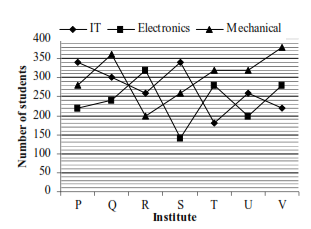
Directions (Q. 1-6): Study the following graph carefully to answer the given questions.
Strength of seven technology institutes with specialisation in IT, Electronics and Mechanical in 2012.


1. If the no. of students with Mechanical specialisation in each institute increased by 20% and the no. of students with Electronics specialisation in each institute decreased by 15% from 2012 to 2013, the total no. of students with Mechanical from all the institutes in 2013 is approximately what per cent of the total no. of students with Electronics specialisation from all the institutes in 2013?
1) 122 
2) 116 
3) 162 
4) 132 
5) 178

2. What is the ratio of the total no. of students in institute R to that in V?
1) 39 : 43 
2) 39 : 44 
3) 37 : 44 
4) 39 : 45 
5) 38 : 43

3. What is the difference between the total no. of students with IT specialisation from all the  institutes together and the total no. of students with Mechanical specialisation from all the institutes together?
1) 260 
2) 240 
3) 280 
4) 220 
5) 250

4. If the no. of students in institutes P, Q and R with IT specialisation increased by 15%, 22% and 10% respectively from 2012 to 2013, what was the total no. of students with IT specialisation in the three institutes together in 2013?
1) 1028 
2) 1056 
3) 1043 
4) 1142 
5) 1145

5. If out of the total no. of students for all three specialisations together in Institute Q, the no. of
students having liking for Music, Painting and Cricket are in the ratio of 5 : 6 : 7, then what is the no. of students having liking for Music from this institute?
1) 250 
2) 300 
3) 350 
4) 360 
5) 280

6. In institutes P, T and U the percentage of girls out of total no. of students with Electronics specialisation in the respective institutes is 50%, 55% and 48% respectively, what is the total no. boys in these three institutes with Electronics specialisation?
1) 340 
2) 386 
3) 356 
4) 360 
5) 314

Directions (Q. 7-12): Study the table and answer the given questions:
Advertisement revenues (in ` thousand) generated from Printed Version (PV) and Online Version (OV) of 6 magazines during 6 months


7. Which of the given statements is/are true? 
(A) Total advertisement revenue generated from online version by magazine T in all the given months together is exactly 44% less than the total advertisement revenue generated from printed
version by the same magazine in all the given months together.
(B) The difference between advertisement revenue generated (from both online and printed version)
by all the given magazines in January and advertisement revenue generated (from both Online and Printed version) by all the given magazines in June is `62000.
(C) Only for one magazine the advertisement revenue generated from printed version displayed a
constant increase from the previous month during the given 6-month period.
1) Only (B) and (C) 
2) Only (A) and (B)
3) Only (A) 
4) Only (B)
5) All (A), (B) and (C)

8. Total advertisement revenue generated from online version by Magazine U in all the given months together is by what per cent more than the total advertisement revenue generated from printed version by the same magazine in all the given months together?
1) 25 
2) 27.5 
3) 35 
4) 30 
5) 32.5

9. In case of Magazine R, between which two given months was there approxi mately 15% rise in advertisement revenues generated (from both Printed and Online version together)?
1) January-February 
2) February-March
3) May-June 
4) March-April
5) April-May

10. The ratio of advertisement revenue generated from printed version by Magazine P to advertisement revenue generated from online version by the same magazine in July is the same as the ratio of advertisement revenue generated from printed version by Magazine Q to advertisement revenue generated from online version by the same magazine in March. If the advertisement revenue generated from online version by Magazine P in July was `1,08,000, what was the advertisement revenue generated from the printed version by the same magazine in July?
1) `1,87,000 
2) `1,53,000 
3) `1,36,000
4) `1,70,000 
5) `1,19,000

11. What is the ratio of the total advertisement revenue generated from online version of all the given magazines together  in February to the total advertisement revenue generated from printed version of all the given magazines together in May?
1) 33 : 28 
2) 39 : 28 
3) 27 : 16 
4) 33 : 20 
5) 27 : 22

12. The total advertisement revenue generated from printed version by Magazine P in January and April together is what  per cent  less than the total advertisement revenue generated from online version by magazine S in February and June together?
1) 22 
2) 14 
3) 27 
4) 19 
5) 17

Answer:-

1. (5); 
Total number of students with Mechanical specialisation in 2013  = 2544
Total number of students with Electronics specialisation in 2013 = 1428

Reqd % = (2544 / 1428) * 100 = 178.15 = 178%

2. (2); 
Reqd ratio =  780 / 880 = 39 : 44

3. (4); 
Number of students with IT specialisation = 340 + 300 + 260 + 340 + 180 + 260 + 220 = 1900
Number of students with Mechanical specialisation = 280 + 360 + 200 + 260 + 320 + 320 + 380 = 2120 
Difference = 2120 – 1900 = 220

4. (3); 
Total number of students in Institutes P, Q and R with IT specialisation in 2013
=  340/100 * 115 + 300/100 * 122 + 260/100 *110
=  391 + 366 + 286 = 1043

5. (1); 
Total number of students in Institute Q = 240 + 300 + 360 = 900
The number of students liking music from Institute Q = 900 * 5 / 18 =250

6. (1); 
The number of boys in Institutes P, T and U with Electronic specialisation = 340

7. (4); 
Check options one by one. 
(A) Total revenue generated from Online version by Magazine T = 209 + 217 + 185 +
156 + 139 + 144 = `1050 thousand Total revenue generated form Printed version by Magazine T = 152 + 186 + 116 + 129 + 187 + 154 = `924 thousand Online version revenue is more than Printed version revenue. Thus, (A) is not true.
(B) Total revenue generated by all the given magazines in January = 169 + 163 + 201 +
145 + 136 + 141 + 209 + 168 + 152 + 209 + 131 + 184 = `2008 thousand = `2008000
Total revenue generated by all the given magazines in June = 172 + 141 + 142 + 163
+ 178 + 243 + 211 + 177 + 154 + 144 + 151 + 194 = 2070 ?  Difference = 2070 – 2008 = 62 thousand = `62000. Hence, B is true.
(C) Neither type of magazines shows constant increase in its revenue from previous month.
Hence (C) is not true. Thus, only (B) is true.

8. (3); 
Total revenue generated from Online version by Magazine U = 184 + 190 + 219 + 236 + 111 + 194 = `1134 thousand 
Total revenue generated from Printed version by magazine U = 131 + 98 + 118 + 174 + 168 + 151 = `840 thousand
Reqd % = (1134 - 840) *100 / 840 

9. (4); 
% rise from Jan to Feb (305-277) * 100 / 277 = 10.10%
Similarly, Feb to Mar  (326-305) * 100 / 305 = 6.88%
March to April =  (375-326)* 100 / 326 = 15%
April to May = (405-375)*100 / 375 = 8%
May to June = (421-405) *100 / 405 = 3.9%
Hence the required answer is March to April.

10. (2); 
The ratio of revenue generated by Magazine P in July is same as the ratio of revenue generated by Q in March.
Reqd ratio of Q from printed version to online version in March = 204 : 144 = 17 : 12
Revenue generated by P in July from printed version = 108000*17/12 = 153000

11. (1); 
Reqd ratio = (171 + 139 + 149 + 223 + 217 + 190) : (113 + 128 + 196 + 132 + 187 + 168) = 1089 : 924 = 33 : 28

12. (5); 
Total revenue generated from printed version by Magazine P in January and April = 169 + 163 = 332
Total revenue generated from Online version by magazine S in February and June = 223 + 177 = 400