Quant Quiz For SBI Primarily Exam 2015

Directions (Q. 1-10): What should come in place of question mark (?) in the following questions?
1. 748 ÷ 17 = ? % of 110
1) 25
2) 40
3) 50
4) 75
5) None of these

2. (8)^0.75 x  (4096)^0.25  ÷ (64)^–1  = (8)^?
1) 2.25
2) 3.0
3) 3.25
4) 3.50
5) 3.75

3. 98643 – 21748 = 51212 + ?
1) 24383
2) 24713
3) 25683
4) 25973
5) 26243


4. 3√ 17.576   x 15 = ?
1) 36
2) 39
3) 42
4) 45
5) 48

5. 40% of 60% of 3/5  of 2750 = ?
1) 372 
2) 384 
3) 396 
4) 412 
5) 424

6. 134.27 – 48.76 + 519.08 – 178.60 = ?
1) 421.49 
2) 425.99 
3) 427.89 
4) 431.19 
5) 437.49

7. (36% of 180) ÷ 0.4 = ?
1) 160 
2) 162 
3) 164 
4) 172 
5) 180

8. 44544 ÷ 348 = ?
1) 122 
2) 124 
3) 126 
4) 128 
5) 132

9. (1107 ÷ 27) × 3.5 = ?
1) 141.5 
2) 143.5 
3) 145.5 
4) 147.5 
5) 149.5

10. 12% of 15% of 40% of 27500 = ?
1) 192 
2) 194 
3) 196 
4) 198 
5) 204

1. (2); (? x 110) /100  = 748 ÷ 17 = 44
              or, ? = 440/11 =  40

2. (5); 8^?  = (8)^0.75 × (8^4)^0.25  ÷ (8^2)^–1
       or, 8^?  = (8)^0.75  × (8)^1.0 ÷ (8)^–2
                   = (8)^0.75 + 1 + 2  = (8)^3.75
                ? = 3.75

3. (3); ? = 98643 – 21748 – 51212 = 25683

4. (2); ? =  3√ 17.576   x 15 = 2.6 x 15 = 39

5. (3); ? = 40/100 x 60/100 x 3/5 x 2750  = 396

6. (2); ? = 134.27 – 48.76 + 519.08 – 178.60 = 425.99

7. (2); ? = (180 × 0.36) ÷ 0.4 = 64.8 ÷ 0.4 = 162

8. (4); ? = 44544/348 = 128

9. (2); ? = (1107 ÷ 27) × 3.5 = 41 × 3.5 = 143.5

10. (4); ? = 27500 × 0.12 × 0.15 × 0.4 = 198

quant quiz for sbi primarily exam 2015


Maths Quiz On Time And Work

Q. 1. Six men or tern boys can do a piece of work in fifteen days. How long would it take for 12 men and 5 boys to do the same piece of work?
(a) 6 days
(b) 28 days
(c) 25 days
(d) 7 days
(e) None of these


Q. 2. If 4 workers can make 42 toys in 6 days, how many toys can 12 workers make in 3 days?
(a) 63
(b) 28
(c) 252
(d) 7
(e) None of these

Q. 3. 10 men can complete a piece of work in 15 days and 15 women can complete the same work in 12 days. If all the 10 men and 15 women work together, in how many days will work get completed?
(a) 6
(b) 7 2/3
(c) 6 2/3
(d) 6 1/3
(e) None of these

Q. 4. Three men, four women and six children can complete a work in 7 days . A woman does double the work a man does and a child does half the work a man does. How many women can complete this work in 7 days?
(a) 8
(b) 7
(c) 12
(d) 10
(e) None of these

Q. 5. A sum of money is sufficient to pay P’s wages for 25 days or Q’s wages for 30 days. The money is sufficient to pay the wages of both for
(a) 13 5/11 days
(b) 13 days
(c) 13 6/11 days
(d) 13 7/11 days
(e) None of these

Q. 6. A certain number of men complete a piece of work in 50 days. If there were 8 men more the work could be finished in 10 days less. How many men were originally there?
(a) 40
(b) 50
(c) 32
(d) 25
(e) None of these

Q. 7. A and B together finish a work in 30 days they worked for it for 20 days and then B left. The remaining work was done by A alone in 20 more days. B alone can finish the work in
(a) 48 days
(b) 50 days
(c) 54 days
(d) 60 days
(e) none of these

Q. 8. A can complete a job in 9 days, B in 10 days and C in 15 days. B and C start the work together and are forced to leave after 2 days. The time taken to complete the remaining work is
(a) 13 days
(b) 10 days
(c) 9 days
(d) 6 days
(e) None of these

Q. 9. If 40 men working 9 hours a day can finish a work in 21 days, in how many days will 27 men working 10 hours a day do the same work?
(a) 20 days
(b) 28 days
(c) 29 days
(d) 25 days
(e) None of these


Q. 10. 8 children and 12 men complete a certain piece of work in 9 days. Each child takes twice the time taken by a man to finish the work. In how many days will 12 men finish the same work?
(a) 8
(b) 15
(c) 9
(d) 12
(e) None o f these

Answer:-
1. (a) 6 days
Explanation:
6 men = 10 boys
Then, 1 boy = 6/10 men = 3/5 men
Then, 5 boys = 3/5 × 5 = 3 men
12 men + 5 boys = 15 men
1 work done = 6 men × 15 days
Therefore, 6 × 15 = 15 × ? days
? days = 6 × 15/15 = 6 days. Ans.

2. (a) 63
Explanation:
4 workers in 3 days make 21 toys,
Then, 1 worker can make 21/4 toys in 3 days
Therefore, No. of toys made by 12 workers in 3 days = 21/4 × 12 = 63 toys. Ans.

3. (c) 6 2/3
Explanation:
If A can complete a work in x days and B can complete the same work in y days, then, both of them together can complete the work in x y/ x+ y days.
Here, men’s working days can be taken as A and that of women as B
Then, 15 × 12/27 = 6 2/3 days.Ans.

4. ( b) 7
Explanation:
3 men = 3/2 women
1 child = 1/2/2 = ¼ woman
Then, 6 children = ¼ × 6 = 6/4 = 3/2 women
Then, 3/2 women + 4 women + 3/2 women = 7 women
7 women does the work in 7 days.
Therefore, the No. of women required to finish the work in 7days = 7. Ans

5. (d) 13 7/11
Explanation:
If A can complete a work in x days and B can complete the same work in y days, then, both of them together can complete the work in x y/ x+ y days.
Here, wages can be taken as days,
Then, 25 ×30/ 55 = 13 7/11 days. Ans.

6. (c) 32
Explanation:
Let the original No. of men = x
Then, I work done = 50x
Then, 50x = (x + 8) 40
50x = 40x + 320
10 x = 320
x = 320/10 = 32 men. Ans.

7. (d) 60 days
Explanation:
(A + B)’s 1 days work = 1/30
A+B ‘s 20 days work = 1/30 × 20 = 2/3
Remaining work = 1 -2/3 = 1/3
1/3 of the work is done by A in 20 days
Therefore, A can complete the full work in 3 × 20 = 60 days
So, A’s 1 day’s work = 1/60
Then, B’s 1 day work = 1/30 – 1/60 = 1/60
Therefore, B can complete the work in 60 days. Ans.

8. (d) 6 days
Explanation:
A’s 1 day work = 1/9
B’s 1 day work = 1/10
C’s 1 day work = 1/15
B + C ‘ s 1 day work = 1/10 + 1/15 = 1/6
B + C’s 2 day’s work = 1/6 × 2 = 1/3
The work remaining = 1 – 1/3 = 2/3
A can do the full work in 9 days.
So, the remaining 2/3 of the work is done by A in 2/3 × 9 days = 6 days. Ans.

9. (b) 28 days
Explanation:
That is, 1 work done = 40 × 9 × 21
Then, 40 × 9 × 21 = 27 × 10 × ? days
Therefore, ? days = 40× 9 × 21 /27 × 10 = 28 days. Ans.

10. (d) 12
Explanation:
8 children = 4men
Then, 4 + 12 = 16 men completes the job in 9 days
Then, 16 × 9 = 12 × ? days
? days = 16 × 9/12 = 12 days. Ans.

maths quiz on time and work


Math Quiz : IBPS Exam

Directions (Q. 1-5): Study the table and answer the given questions:
Data related to human resource of a multinational company (X) which has 145 offices across 8 countries 113.

1. If the number of male postgraduate employees in Country H is 1800, what per cent of the female employees in that particular country are postgraduate?

1) 76
2) 74
3) 72
4) 64
5) 68

2. In which of the given countries is the percentage of women employees with respect to the total number of employees (both males and females) in that country the second lowest?
1) G
2) B
3) E
4) H
5) D

3. What is the ratio of the total number of male employees in countries B and H together to the total number of female employees in countries C and D together?
1) 63 : 52
2) 51 : 38
3) 77 : 64
4) 69 : 44
5) 57 : 40

4. What is the difference between the average number of postgraduate employees in countries A, B and D together and the average number of postgraduate employees in countries F, G and H?
1) 282
2) 276
3) 316
4) 342
5) 294

5. Which of the given countries has the highest number of average employees per office?
1) F
2) H
3) B
4) C
5) D

Directions (Q. 6-11): Study the following graph carefully to answer the given questions.
Number of students playing Carrom, Cricket and Hockey from different schools


6. The total number of students playing Carrom and Hockey together from school P is what per cent of the total no. of students playing these two games together from school R?

1) 68
3
16
           
2) 62 
3
13
3) 69 
3
13
4) 63 
3
13
5) 62 
3
16


7. If the no. of students playing each game in school S is increased by 15% and the no. of students playing each game in school Q is decreased by 5%, what will be the difference between the no. of students in school S and Q?
1) 54 
2) 218 
3) 356 
4) 224 
5) 205

8. If out of the students playing Cricket from schools Q, S and T, 40%, 35% and 45% respectively got selected for State level competition, what is the total no. of students who got selected for State level competition from these three schools together?
1) 346 
2) 241 
3) 292 
4) 284 
5) 268

9. The total number of students playing Hockey from all schools together is approximately what per cent of the total number of students playing Cricket from all schools together?
1) 84 
2) 74 
3) 72 
4) 79 
5) 70

10. From school P, out of the students playing Carrom, 40% got selected for State level competition, out of which 25% further got selected for National level competition. From school T, out of the students playing Carrom, 45% got selected for State level competition, out of which two-thirds further got selected for National level competition. What is the total no. of students playing Carrom from these two schools who got selected for National level competition?
1) 106 
2) 98 
3) 112 
4) 108 
5) 96

Quant Quiz On Data Interpretation(DI)

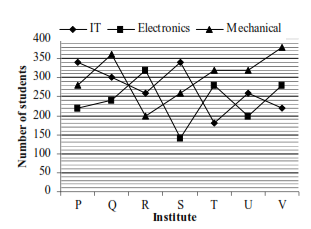
Directions (Q. 1-6): Study the following graph carefully to answer the given questions.
Strength of seven technology institutes with specialisation in IT, Electronics and Mechanical in 2012.


1. If the no. of students with Mechanical specialisation in each institute increased by 20% and the no. of students with Electronics specialisation in each institute decreased by 15% from 2012 to 2013, the total no. of students with Mechanical from all the institutes in 2013 is approximately what per cent of the total no. of students with Electronics specialisation from all the institutes in 2013?
1) 122 
2) 116 
3) 162 
4) 132 
5) 178

2. What is the ratio of the total no. of students in institute R to that in V?
1) 39 : 43 
2) 39 : 44 
3) 37 : 44 
4) 39 : 45 
5) 38 : 43

3. What is the difference between the total no. of students with IT specialisation from all the  institutes together and the total no. of students with Mechanical specialisation from all the institutes together?
1) 260 
2) 240 
3) 280 
4) 220 
5) 250

4. If the no. of students in institutes P, Q and R with IT specialisation increased by 15%, 22% and 10% respectively from 2012 to 2013, what was the total no. of students with IT specialisation in the three institutes together in 2013?
1) 1028 
2) 1056 
3) 1043 
4) 1142 
5) 1145

5. If out of the total no. of students for all three specialisations together in Institute Q, the no. of
students having liking for Music, Painting and Cricket are in the ratio of 5 : 6 : 7, then what is the no. of students having liking for Music from this institute?
1) 250 
2) 300 
3) 350 
4) 360 
5) 280

6. In institutes P, T and U the percentage of girls out of total no. of students with Electronics specialisation in the respective institutes is 50%, 55% and 48% respectively, what is the total no. boys in these three institutes with Electronics specialisation?
1) 340 
2) 386 
3) 356 
4) 360 
5) 314

Directions (Q. 7-12): Study the table and answer the given questions:
Advertisement revenues (in ` thousand) generated from Printed Version (PV) and Online Version (OV) of 6 magazines during 6 months


7. Which of the given statements is/are true? 
(A) Total advertisement revenue generated from online version by magazine T in all the given months together is exactly 44% less than the total advertisement revenue generated from printed
version by the same magazine in all the given months together.
(B) The difference between advertisement revenue generated (from both online and printed version)
by all the given magazines in January and advertisement revenue generated (from both Online and Printed version) by all the given magazines in June is `62000.
(C) Only for one magazine the advertisement revenue generated from printed version displayed a
constant increase from the previous month during the given 6-month period.
1) Only (B) and (C) 
2) Only (A) and (B)
3) Only (A) 
4) Only (B)
5) All (A), (B) and (C)

8. Total advertisement revenue generated from online version by Magazine U in all the given months together is by what per cent more than the total advertisement revenue generated from printed version by the same magazine in all the given months together?
1) 25 
2) 27.5 
3) 35 
4) 30 
5) 32.5

9. In case of Magazine R, between which two given months was there approxi mately 15% rise in advertisement revenues generated (from both Printed and Online version together)?
1) January-February 
2) February-March
3) May-June 
4) March-April
5) April-May

10. The ratio of advertisement revenue generated from printed version by Magazine P to advertisement revenue generated from online version by the same magazine in July is the same as the ratio of advertisement revenue generated from printed version by Magazine Q to advertisement revenue generated from online version by the same magazine in March. If the advertisement revenue generated from online version by Magazine P in July was `1,08,000, what was the advertisement revenue generated from the printed version by the same magazine in July?
1) `1,87,000 
2) `1,53,000 
3) `1,36,000
4) `1,70,000 
5) `1,19,000

11. What is the ratio of the total advertisement revenue generated from online version of all the given magazines together  in February to the total advertisement revenue generated from printed version of all the given magazines together in May?
1) 33 : 28 
2) 39 : 28 
3) 27 : 16 
4) 33 : 20 
5) 27 : 22

12. The total advertisement revenue generated from printed version by Magazine P in January and April together is what  per cent  less than the total advertisement revenue generated from online version by magazine S in February and June together?
1) 22 
2) 14 
3) 27 
4) 19 
5) 17

Answer:-

1. (5); 
Total number of students with Mechanical specialisation in 2013  = 2544
Total number of students with Electronics specialisation in 2013 = 1428

Reqd % = (2544 / 1428) * 100 = 178.15 = 178%

2. (2); 
Reqd ratio =  780 / 880 = 39 : 44

3. (4); 
Number of students with IT specialisation = 340 + 300 + 260 + 340 + 180 + 260 + 220 = 1900
Number of students with Mechanical specialisation = 280 + 360 + 200 + 260 + 320 + 320 + 380 = 2120 
Difference = 2120 – 1900 = 220

4. (3); 
Total number of students in Institutes P, Q and R with IT specialisation in 2013
=  340/100 * 115 + 300/100 * 122 + 260/100 *110
=  391 + 366 + 286 = 1043

5. (1); 
Total number of students in Institute Q = 240 + 300 + 360 = 900
The number of students liking music from Institute Q = 900 * 5 / 18 =250

6. (1); 
The number of boys in Institutes P, T and U with Electronic specialisation = 340

7. (4); 
Check options one by one. 
(A) Total revenue generated from Online version by Magazine T = 209 + 217 + 185 +
156 + 139 + 144 = `1050 thousand Total revenue generated form Printed version by Magazine T = 152 + 186 + 116 + 129 + 187 + 154 = `924 thousand Online version revenue is more than Printed version revenue. Thus, (A) is not true.
(B) Total revenue generated by all the given magazines in January = 169 + 163 + 201 +
145 + 136 + 141 + 209 + 168 + 152 + 209 + 131 + 184 = `2008 thousand = `2008000
Total revenue generated by all the given magazines in June = 172 + 141 + 142 + 163
+ 178 + 243 + 211 + 177 + 154 + 144 + 151 + 194 = 2070 ?  Difference = 2070 – 2008 = 62 thousand = `62000. Hence, B is true.
(C) Neither type of magazines shows constant increase in its revenue from previous month.
Hence (C) is not true. Thus, only (B) is true.

8. (3); 
Total revenue generated from Online version by Magazine U = 184 + 190 + 219 + 236 + 111 + 194 = `1134 thousand 
Total revenue generated from Printed version by magazine U = 131 + 98 + 118 + 174 + 168 + 151 = `840 thousand
Reqd % = (1134 - 840) *100 / 840 

9. (4); 
% rise from Jan to Feb (305-277) * 100 / 277 = 10.10%
Similarly, Feb to Mar  (326-305) * 100 / 305 = 6.88%
March to April =  (375-326)* 100 / 326 = 15%
April to May = (405-375)*100 / 375 = 8%
May to June = (421-405) *100 / 405 = 3.9%
Hence the required answer is March to April.

10. (2); 
The ratio of revenue generated by Magazine P in July is same as the ratio of revenue generated by Q in March.
Reqd ratio of Q from printed version to online version in March = 204 : 144 = 17 : 12
Revenue generated by P in July from printed version = 108000*17/12 = 153000

11. (1); 
Reqd ratio = (171 + 139 + 149 + 223 + 217 + 190) : (113 + 128 + 196 + 132 + 187 + 168) = 1089 : 924 = 33 : 28

12. (5); 
Total revenue generated from printed version by Magazine P in January and April = 169 + 163 = 332
Total revenue generated from Online version by magazine S in February and June = 223 + 177 = 400

Quant Quiz For NICL Exam

Q. 1. 5 men can do a piece of work in 6 days while 10 women can do it in 5 days. In how many days can 5 women and 3 men do it?
(a) 4
(b) 5
(c) 6
(d) 8
(e) None of these

Q. 22. A work could be completed in 100 days. However, due to the absence of 10 workers, it was completed in 110 days then, the original number of workers was
(a) 100
(b) 110
(c) 55
(d) 50
(e) None of these

Q. 23. A particular job can be completed by a team of 10 men in 12 days. The same job can be completed by a team of 10 women in 6 days. How many days are needed to completed the job if the  two teams work together?
(a) 4
(b) 6
(c) 9
(d) 18
(e) None of these

Q. 24. A can do a piece of work in 12 days, while B can do it in 8 days with the help of C, they finish the work in 4 days. Then C alone can do the work in
(a) 24 days
(b) 20 days
(c) 16 days
(d) 4 days
(e) None of these

Q. 25. A job can be completed by 12 men in 12 days. How many extra days will be needed to complete the job if 6 men leave after working for 6 days?
(a) 3
(b) 12
(c) 6
(d) 24
(e) None of these

Q. 26. Worker A takes 8 hours to do a job. Worker B takes 10 hours to do the same job. How long should it take, worker A and worker B, working together but independently, do the same job?
(a) 4 1/9 hours
(b) 4 2/9 hours
(c) 4 4/9 hours
(d) 4 5/9 hours
(e) None of these

Q. 27. Three workers working all days can do a work in 10 days. But one of them having other employment can work only half time. In how many days the work can be finished?
(a) 15 days
(b) 16 days
(c) 12 days
(d) 12.5 days
(e) None of these

Q. 28. Sam, Bob and Kim can do a job alone in 15 days, 10 days and 30 days respectively. Sam is helped by Bob and Kim every third day. In how many days will the job be completed?
(a) 9 days
(b) 8 1/3 days
(c) 8 days
(d) 6 1/3 days
(e) None of these

Q. 29. Prakash alone can complete a job in 12 hours, Jayant alone can complete the same job in 6 hours. How many hours will they take together to complete the job?
(a) 4
(b) 6
(c) 2
(d) 8
(e) None of these

Q. 30. 56 men completes a work in 12 days. How many men will be required to complete the work in 16 days?
(a) 38
(b) 24
(c) 42
(d) 48
(e) None of these

Ans: 1. (b) 5
Explanation:
5men × 6 = 10 women × 5
30 men = 50 women
1 woman = 30/50 men = 3/5 men
5 women = 3/5 × 5 men = 3 men
5 women + 3 men = 3 + 3 = 6 men
That is, 1 work done = 5 × 6
5 × 6 = 6 × ?days
? days = 5 × 6/6 = 5 days. Ans.

Ans: 2. (b) 110
Explanation:
Let ‘x’ be the original number of workers
Then, x × 100 = ( x – 10) 110
100 x = 110x – 1100
1100 = 10 x
x = 110. Ans.

Ans: 3. (a) 4
Explanation:
Consider men’s work days as one group and women’s working days as other group
Then, the required No. of days = 12 × 6/18 = 4 days. Ans.

Ans: 4. (a) 24 days
Explanation:
A and B together can do the work in 12 × 8/20 = 96/20 days
A +B and C together do the work in 4 days.
Then C alone can do the work in 96/20 × 4/96/20 – 4 days
= 96/5/16/20 = 96/5 × 20/16 = 24 days. Ans.

Ans: 5. (c) 6
Explanation:
Half the work is done by 12 men in 6 days.
Remaining half should be done by 6 men in ? days
Then, 12 × 6 × ½ = 6 × ?days × ½
36 = 3 × ?days
? days = 36/3 =12 days
Extra days required = 12 -6 = 6 days. Ans.

Ans: 6.  (c) 4 4/9 hours
Explanation:
If A can complete a work in x days and B can complete the same work in y days, then, both of them together can complete the work in x y/ x+ y days.
Then 8 × 10/18 = 4 4/9 hours. Ans.

Ans: 7. (c) 12 days.
Explanation:
Sum of each persons’ one day’s work = 1/3 ×10 + 1/3 ×10 + 1/3× 20 = 1/30 + 1/30 + 1/60
= 5/60 = 1/12
Therefore, the work can be finished in 12 days. Ans.

Ans: 8. (a) 9 days
Explanation:
The work done by the three persons in 3 days ( because Sam works only on every third day)
= 3/15 + 1/10 + 1/30 = 6 + 3 + 1/30 = 10/30
= 1/3 of the work
Therefore, the job will be completed in 3 × 3 = 9 days. Ans.

Ans: 9. (a) 4
Explanation:
If A can complete a work in x days and B can complete the same work in y days, then, both of them together can complete the work in x y/ x+ y days.
Here, the No. of hours required to complete the work , working together = 12 × 6/18
= 4 hours. Ans.

Ans: 10.  (c) 42
Explanation:
1 work done = 56 men × 12 days
Then, 56 ×12 = ? men × 16
? men = 56 × 12/16 = 42 men. Ans.

quant quiz for nicl exam
You Might Also Like :-


Quant Quiz On Time & Work

Q. 1. A can do a piece of work in 5 days and B can do the same work in 10 days. How many days will both take to complete the work?
(a) 5 days 
(b) 3 1/3 days 
(c) 3 days 
(d) 6 days 
(e) None of these

Q. 2. If 12 men can do a piece of work in 24 days, then in how many days can 18 men do the same work?
(a) 36 
(b) 20 
(c) 18 
(d) 16 
(e) None of these

Q. 3. A group of workers accepted to do a piece of work in 25 days. If 6 of them did not turn for the work and the remaining workers did the work in 40 days, then the original number of workers was
(a) 22 
(b) 20 
(c) 18 
(d) 16 
(e) None of these

Q. 4. If 8 men or 12 women can do a piece of work in 10 days, then the number of days required by 4 men and 4 women to finish the work is
(a) 8 
(b) 10 
(c) 12 
(d) 4 
(e) None of these

Q. 5. If 8 men can dig a well in 18 days, then the number of days, 12 men will take to dig the same well will be
(a) 12 days 
(b) 10 days 
(c) 8 days 
(d) 16 days 
(e) None of these

Q. 6. 39 men can repair a road in 12 days working 5 hours a day. In how many days will 30 men working 6 hours peer day complete the work?
(a) 10 
(b) 13 
(c) 14 
(d) 15 
(e) None of these

Q. 7. A certain number of men can do a work in 40days. If there were 8 men more, it could be finished in 10 days less. How many men were there initially?
(a) 30 
(b) 24 
(c) 16 
(d) 20 
(e) None of these


Q. 8. If 4 men or 6 boys can finish a work in 20 days. How long will 6 men and 11 boys take to finish the same work?
(a) 10 days 
(b) 6 days 
(c) 4 days 
(d) 3 days 
(e) None of these

Q. 9. A works twice as fast as B. if B can complete a work in 12 days independently. The number of days in which A and B can together finish the work?
(a) 18 days 
(b) 8 days 
(c) 6 days 
(d) 4 days 
(e) None of these

Q. 10. A and B can do a piece of work in 4 days. If A can do it alone in 12 days, B will finish the work in
(a) 4 days 
(b) 6 days 
(c) 8 days 
(d) 10 days 
(e) None of these

Ans: 1.  (b) 3 1/3 days
Explanation:
If A can complete a work in x days and B can complete the same work in y days, then, both of them together can complete the work in x y/ x+ y days. That is, the required No. of days = 5 × 10/15 = 3 1/3 days.

Ans: 2. (d) 16
Explanation:
1 work done = 12 × 24
Then, 12 × 24 = 18 × ? days
? days = 12 × 24/18 = 16.

Ans: 3. (d) 16
Explanation:
Let the original number of workers be ‘x’
Then, x × 25 = (x – 6) × 40
25x = 40x -240
240 = 40x -25x = 15x
x = 240/15 = 16.

Ans: 4. (c) 12
Explanation:
8 men = 12 women
1 woman = 8/12 men = 2/3 men
4 women = 2/3 × 4 men = 8/3 men
4 men + 4 women = 4 + 8/3 men = 20/3 men
1 work done = 8 × 10
8 × 10 = 20/3 × ?days
?days = 8 × 10 × 3/20 = 12 days.

Ans: 5. (a) 12 days
Explanation:
Work done = 8 × 18
Then, 8 × 18 = 12 × ? days
? days = 8 × 18/12 = 12 days.

Ans: 6. (b) 13
Explanation:
1 work done = 39 × 12 × 5
39 × 12 × 5 = 30 × 6 × ?days
? days = 39 × 12 × 5/ 30 × 6 = 13 days.

Ans: 7. (b) 24
Explanation:
Let ‘x’ be the initial number of men
Then, 1 work done = x × 40
Then, x × 40 = (x + 8 ) (40 – 10)
40x = 30x + 240
10x = 240
Therefore, x = 240/10 = 24 men. 

Ans: 8. (b) 6 days
Explanation:
4 men = 6 boys
Then, 1 boy = 4/6 men = 2/3 men
11 boys = 2/3 × 11 men = 22/3 men
Then, 6 men + 11 boys = 6 + 22/3 men = 40/3 men
1 work done = 4 men × 20 days
That is, 4 × 20 = 40/3 × ? days
? days = 4 × 20 × 3/40 = 6 days.

Ans: 9. (d) 4 days
Explanation:
If B takes 12 days to finish the work, then A takes 6 days to finish the same work.
If A can complete a work in x days and B can complete the same work in y days, then, both of them together can complete the work in x y/ x+ y days.
Therefore, the Number of days taken by A and B together to finish the same work = 6 × 12/18 = 4 days.

Ans: 10. (b) 6 days
Explanation:
If A and B together can do a piece of work in x days and A alone can do the same work in y days, then B alone can do the same work in x y/ y – x days.
Therefore, the number of days B will take to finish the work = 4 × 12/ 12 – 4 = 48/8 = 6 days.